Table of Contents
You want to use a planner to get organized and live more intentionally. Good. That's the first step to a more balanced and productive life. The next question is a question of personal preference and alignment with your lifestyle: daily planner or weekly planner?
The format you choose changes how you see your time and where your attention goes, so it's worth your time to understand which format is the best for you. Here's what each one does well, who tends to do best with each, and how to figure out which fits the life you're actually living right now.
What Each Planner Actually Does
A daily planner gives you a full page or spread for each day. Room to lay out your schedule hour by hour, name your top priorities, and work through everything the day actually requires. It's the close-up view.
A weekly planner shows your whole week on one or two pages. You can see how everything is spread across the days, catch the ones that are overloaded, and plan with a little distance instead of just reacting to what's next.
Neither one is better. A daily planner guides how today is going to go. A weekly planner helps you visualize the week ahead.
When a Daily Planner Is the Right Fit
Some days are just full. Back-to-back meetings, a project deadline, school pickup, and all the to-dos you don't want to forget. If that feels like your life, a daily planner lets you write down and see all the details of your life on paper, instead of carrying it around in your head.
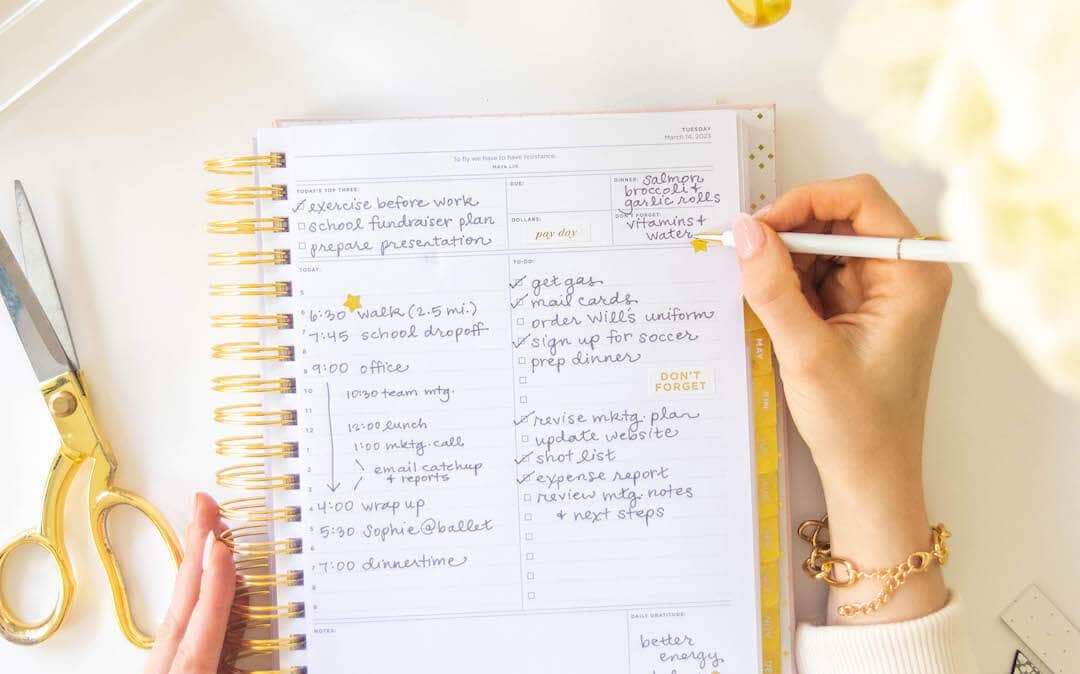
The Day Designer Daily Planner offers a unique approach to daily planning that was designed to reduce overwhelm and bring balance to each day. The daily planning page combines your top three priorities, hourly schedule, and to-do list on the same page. The "Today" hourly layout runs 5 am to 9 pm, which covers the early workout and the evening things, not just the workday. The "To Do" section offers checkboxes so you can mark when tasks are done (so satisfying!) And the "Top Three" section at the top guides you to name what matters most that day before the small stuff crowds it out.
A daily planner is the right fit when:
- Your schedule changes from one day to the next, and you want to stay on top of the details.
- You like to plan each day to balance appointments, meetings, and work that needs focused, uninterrupted blocks of time
- You need to remember many details, and writing them down and checking them off keeps you on track.
- You like having extra space for notes (the Daily Planner leaves room for notes and a few reflection prompts)
Having the whole day on one page reduces your mental load and provides clarity to intentionally design each day. Once written down, you stop spending energy trying to remember it, and that mental juggling is usually where the scattered, behind feeling comes from.
When a Weekly Planner Makes More Sense
Not every week runs hour to hour, and not everyone needs that much detail to feel on top of things.
A weekly planner gives you something the daily format can't as easily: perspective. You see Monday through Sunday at once, which makes it easier to balance what's on your plate, protect time for the things that matter, and notice how your weeks tend to go.
A weekly planner is often the better pick when:
- Your priorities move week to week more than hour to hour
- You want a lighter planning practice that doesn't feel like one more job
- You're planning projects, habits, or goals across a rolling seven days
- Your schedule is pretty steady and doesn't need remapping every morning
If heavy structure makes you feel boxed in, a weekly view gives you a plan with more room to breathe. You still know where you're headed. It's just a lighter touch.
How to Decide (and What to Ask Yourself)
Still stuck on daily planner vs. weekly planner? A few honest questions usually settle it, and you can answer them here or take our two-minute planner quiz. [COPY EDIT — added clause to give the quiz link natural anchor text]
How full is your average day? If your days are packed and time sensitive, a daily planner gives you the structure to handle them. If your days are more open, weekly might be all you need.
When do you actually plan, morning or start of the week? Daily planners work best if you plan in the morning. Weekly planners are built for a Sunday or Monday planning session.
Have you used one format and felt like something was off? That's good information. Too much structure can feel tight. Too little can leave you a little adrift.
What do you want planning to feel like? Grounded and focused, or open and big picture? Both are fair goals.
Honestly, for a lot of women the answer is both. A weekly planner for the big picture and a daily planner for getting it done is a natural combo. Weekly gives you direction. Daily gets you through the day.
A simple comparison:
| Daily Planner | Weekly Planner | |
|---|---|---|
| Best for | Full, detail-heavy days | Flexible or project-based weeks |
| Planning rhythm | Morning or evening check-in | Weekly planning session |
| Level of structure | High | Moderate |
| Great for | Time blocking, daily reflection | Goal tracking, big-picture view |
| Flexibility | Lower | Higher |
The Bottom Line
The best planner is the one that fits how you actually live. This isn't about finding the single right answer. It's about picking the structure that helps you show up the way you want to for your days.
If your days are full and you want to feel in control of them, a daily planner gives you the clearest picture and the most support. That's the heart of what Day Designer makes, and it's why the Daily Planner is our flagship. If you think in weeks and want flexibility alongside your focus, the weekly is a genuinely good fit. And if you want both, there's no rule that says you have to choose.
Ready to Find Your Planning Rhythm?
Start with our free Daily Planning Printable and Weekly Printable to test the format that works best for you, or browse more free printables to test-drive before you commit. When you're ready, take a look at the Day Designer Daily Planner and Weekly Planner collections and find the one that fits your life.